

The No-Fluff Guide to Building a Short-Form Video Sales Funnel
You have probably heard that short-form video is the future of marketing. You see the millions of views on TikTok, the endless scrolling on Instagram Reels, and the explosive growth of YouTube Shorts. But here is the reality most gurus won’t tell you: views are a vanity metric. If those views do not lead to a sale, they are just noise.
Building a short-form video funnel is not about going viral. It is about creating a deliberate path that takes a complete stranger from a 15-second clip to a confirmed purchase. You do not need a massive following or a Hollywood budget to make this work. You just need a system.
Why Most Short-Form Video Strategies Fail
Most creators fail because they treat short-form video as a standalone piece of content rather than a gear in a larger machine. They post a funny video, get 10,000 views, and then wonder why their bank account hasn’t changed.
The problem is a lack of intent. If your video does not give the viewer a clear next step, they will simply swipe to the next creator. To win, you have to stop thinking like an entertainer and start thinking like a direct-response marketer. You are not just making videos; you are building a bridge.
The Three Stages of a Video-First Funnel
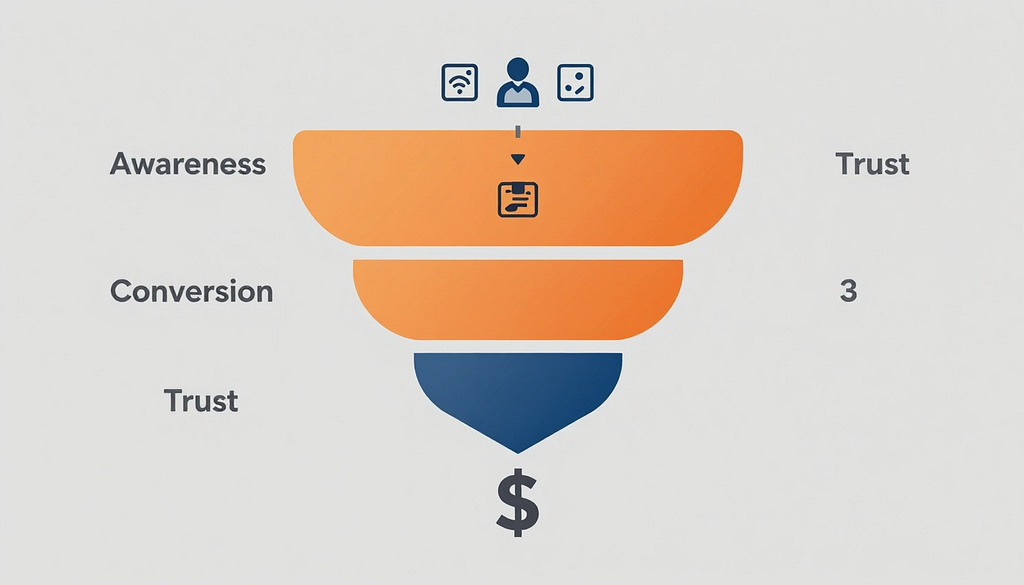
A high-converting funnel is broken down into three distinct phases. Each phase requires a different type of video and a different call to action.
Stage 1: Awareness (The Hook)
At the top of your funnel, your only goal is to stop the scroll. You are competing with dopamine-fueled algorithms, so you have about 1.5 seconds to prove your value.
Forget the long introductions. Do not start with “Hi, my name is…” Nobody cares yet. Start with the problem you solve or a result you achieved. Use a strong visual hook or a bold statement that makes your target audience feel seen. This stage is about casting a wide net to find the people who actually have the problem you solve.
Stage 2: Trust (The Educational Bridge)
Once you have their attention, you need to prove you know what you are talking about. This is where most people drop the ball. They try to sell too early.
In the middle of your funnel, your videos should focus on education and authority. Share a specific tip, debunk a common myth in your industry, or show a behind-the-scenes look at your process. You want the viewer to think, “This person actually understands my situation.”
This is also where you transition the viewer from the social media platform to your own ecosystem. Whether it is a lead magnet, a newsletter, or a low-cost digital product, you need to capture their information. Short-form video is rented land; your email list is land you own.
Stage 3: Conversion (The Frictionless Close)
This is the bottom of the funnel. These videos are for the people who have seen your content, trust your expertise, and are on the fence about buying.
Conversion videos should be direct. Use customer testimonials, address specific objections, or do a deep-dive demonstration of your product. Your call to action here should be singular and unmistakable: “Click the link in my bio to join,” or “Buy the starter pack here.”
Debunking the High-Production Myth
You might think you need a 4K camera, a ring light, and a professional editor to start a short-form video funnel. You don’t. In fact, overly polished videos often perform worse on platforms like TikTok because they look like ads.
Authenticity wins every time. A video shot on an iPhone in your office with decent natural light will often out-convert a high-budget production. People buy from people they trust, and nothing builds trust faster than a raw, honest conversation. Your expertise is the value, not your color grading.
Measuring What Actually Matters
If you want to know if your funnel is working, stop looking at likes. Instead, look at these three metrics:
1. Retention Rate: Are people watching your videos until the end? If not, your hook or your pacing is off.
2. Link Clicks: How many people are actually clicking the link in your bio or your description?
3. Conversion Rate: Of the people who clicked, how many signed up for your lead magnet or bought your product?
If your retention is high but your clicks are low, your call to action is weak. If your clicks are high but your conversions are low, your landing page is the problem. This data tells you exactly where the leak in your funnel is so you can fix it.
Start Small and Iterate
You do not need to record 50 videos today. Start by creating one video for each stage of the funnel. Post them, look at the data, and refine your approach. The beauty of short-form video is that it provides an immediate feedback loop. You will know within 24 hours if a concept resonates with your audience.
Stop waiting for the perfect moment or the perfect script. The algorithm favors those who show up consistently and provide genuine value. Build your bridge, one video at a time.
Ready to scale your business with a strategy that actually works? Contact our team today for a custom funnel audit and let’s turn your content into a revenue engine.